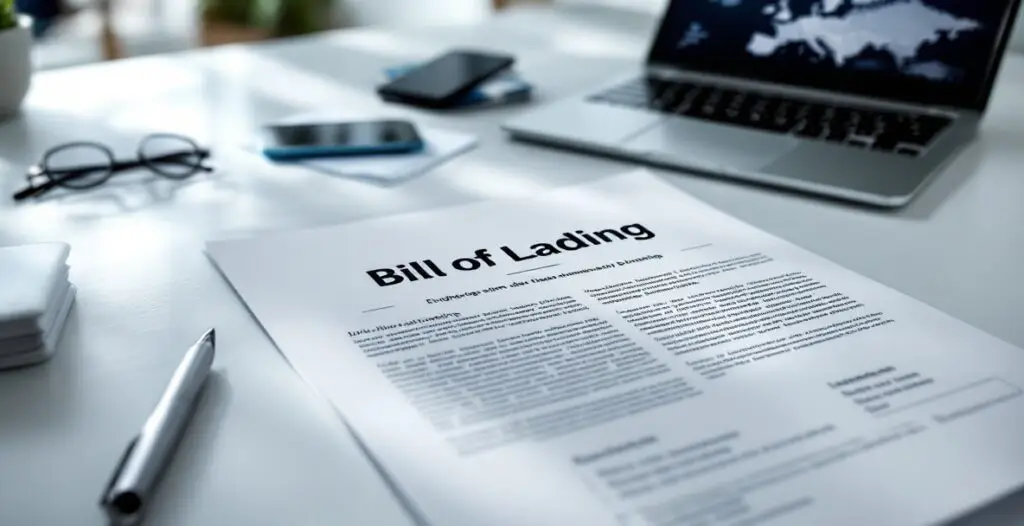
A bill of lading (cognossement) is the document a sea carrier issues to confirm that it has received goods for shipment. It is a receipt, evidence of the contract of carriage and, in negotiable form, a document of title: the lawful holder of the original can claim the goods, and the goods can be sold in transit by transferring the document.
The main exception concerns the straight bill, which names one consignee and cannot be transferred by endorsement. In Dutch law, the bill of lading is governed by Book 8 of the Dutch Civil Code (BW), in particular Articles 8:399 to 8:441 BW, and the Hague-Visby Rules apply through Article 8:371 BW.
What are the three functions of a bill of lading?
A bill of lading is a receipt, a contract document and a document of title at the same time. Most disputes come from confusing these three functions.
- Cuidhteas: the carrier confirms that it took the goods on board in the stated quantity and apparent condition (Article 8:399 BW).
- Evidence of the contract of carriage: the terms printed on or referred to in the bill govern the relationship between carrier and holder.
- Document of title: under Article 8:441 BW, the lawful holder has the right to delivery of the goods, or to damages if the carrier fails to deliver.
Against a third party who acquired the bill in good faith, the carrier cannot prove that the goods were not as described (Article 8:414 BW). That is why the description and any remarks on the bill matter so much.
What information must a bill of lading contain?
Article 8:412 BW requires, among other things, the date, the signature of the carrier, the place of issue and the person to whom the goods must be delivered. In practice the bill also contains the following data.
- the shipper, the consignee (or “to order”) and the notify party;
- a description of the goods, the number of packages, the weight and the shipping marks;
- the vessel, the voyage and the ports of loading and discharge;
- the freight terms, such as “freight prepaid” or “freight collect”;
- the number of originals issued, usually three; once one original is used to take delivery, the others lose their effect.
Which types of bill of lading exist?
The type determines who can claim the goods and whether the bill can be traded. Banks financing a sale under a letter of credit usually require a clean, negotiable bill.
- Order bill: negotiable; it is transferred by endorsement and delivery of the original (Articles 8:416 and 8:417 BW).
- Straight bill: names one consignee and is not negotiable by endorsement.
- Bearer bill: whoever holds it may claim the goods; rarely used because of the fraud risk.
- Clean or claused bill: a clean bill has no remarks about damage; a claused bill records visible defects at loading.
- Combined transport bill: covers carriage by more than one mode of transport.
What happens if the carrier delivers without the original?
A carrier that releases goods without the original negotiable bill does so at its own risk. It is liable to the lawful holder under Article 8:441 BW, even if the party collecting the goods appeared to be the buyer.
When the original arrives late, carriers often ask for a letter of indemnity (LOI) from the receiver before delivering. The LOI shifts the risk to the receiver and its bank, but it does not take away the holder’s claim against the carrier.
How does the carrier’s liability work?
Under the Hague-Visby Rules, which apply through Article 8:371 BW, the carrier is liable for loss of or damage to the goods unless it can rely on a listed exception. Its liability is limited per package or per kilogram, unless the shipper declared a higher value in the bill.
Claims must be brought within one year after delivery, or after the date on which the goods should have been delivered (Article 8:1711 BW). The Rotterdam Rules, which are sometimes mentioned in contracts, are not in force.
Is an electronic bill of lading valid in the Netherlands?
Yes, under new rules in Book 8 BW; the date of entry into force is set by royal decree. The Act introducing the electronic bill of lading (bill 36743) was adopted by the Senate (Eerste Kamer) on 31 March 2026 and gives an electronic bill the same effect as a paper one if it uses a reliable method to secure authenticity, control and integrity (new Articles 8:400 to 8:402 BW).
The carrier and the shipper must agree to use an electronic bill; the shipper cannot force it. Control of the electronic bill has the same effect as holding the paper original. See the announcement by the Dutch government.
What should you check as a shipper or seller?
As shipper, you supply the data for the bill and you depend on it for payment. Check the draft before the carrier issues the originals.
- Does the description of the goods match the commercial invoice and the letter of credit?
- Is the bill clean, without remarks that the bank may refuse?
- Is the on-board date within the shipment period of the sales contract?
- Is the consignee correct, or is the bill made out “to order”?
- Do you keep control of all originals until you are paid?
What should you check as a buyer or consignee?
As buyer, the bill is your key to the goods. Without the original, or control of the electronic bill, the carrier should not deliver to you.
- Is the bill correctly endorsed to you, without gaps in the chain of endorsements?
- Do the remarks on the bill match the condition of the goods on arrival?
- Do you record damage on delivery and notify the carrier in writing straight away?
- Do you start a claim, or agree an extension of time, within the one-year limit of Article 8:1711 BW?
- Which law and which court does the jurisdiction clause in the bill designate?
What can we do for you with bills of lading?
We advise shippers, traders and receivers on shipping documents as part of our work as neach-lagha corporra.
- We review your draft bill of lading against the sales contract and the letter of credit.
- We assess a letter of indemnity before you sign it.
- We claim delivery or damages from the carrier under Article 8:441 BW.
- We secure your claim within the one-year limit, for example by agreeing an extension with the carrier.
- We advise on the switch to electronic bills of lading under the new rules in Book 8 BW.
Geàrr-chunntas
- A bill of lading is a receipt, evidence of the contract of carriage and, in negotiable form, a document of title.
- The lawful holder of the original can claim the goods (Article 8:441 BW); a carrier that delivers without it is liable.
- The Hague-Visby Rules apply through Article 8:371 BW; claims expire after one year (Article 8:1711 BW).
- Under the amendment of Book 8 BW adopted in March 2026, an electronic bill can have the same effect as a paper bill.
Ceistean Àbhaisteach
Who can claim the goods under a bill of lading?
The lawful holder of the original negotiable bill, or the named consignee of a straight bill. Under Article 8:441 BW the holder can claim delivery or damages from the carrier.
What is the difference between a clean and a claused bill of lading?
A clean bill contains no remarks about the condition of the goods. A claused bill records visible damage or shortages at loading, and banks often refuse it under a letter of credit.
How long do I have to claim against the carrier?
One year after delivery, or after the date on which the goods should have been delivered (Article 8:1711 BW). You can agree an extension with the carrier in writing.
Is an electronic bill of lading legally valid in the Netherlands?
Yes, under the new Articles 8:400 to 8:402 BW, if it uses a reliable method for authenticity, control and integrity and the carrier and shipper agreed to use it.