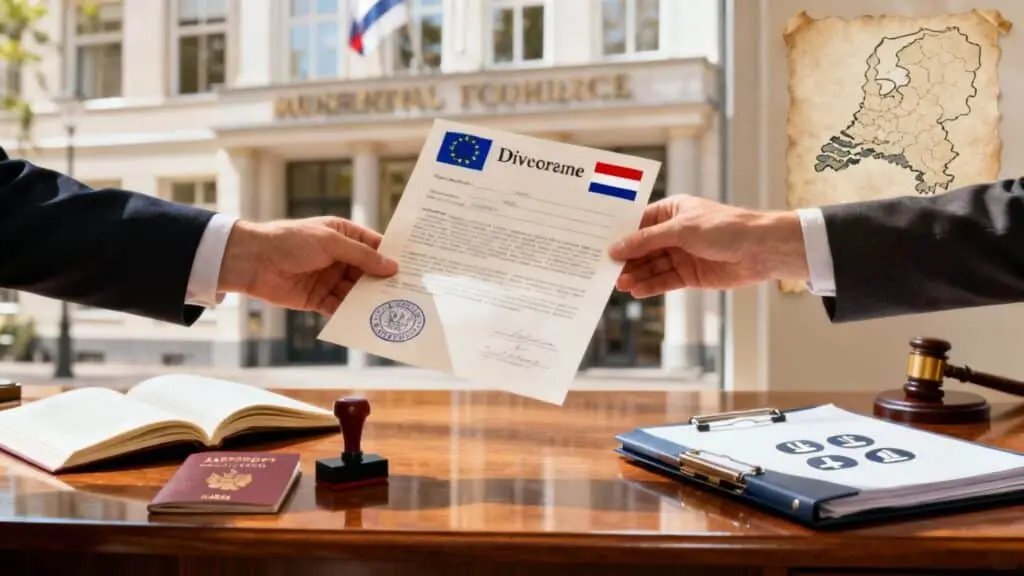
Tha sgaradh-pòsaidh cèin air aithneachadh anns na Tìrean Ìsle tro obrachadh an lagha, cho luath ‘s a choinnicheas e ris na cumhaichean iomchaidh: chan eil modh-obrach aithneachaidh fa leth ann, agus is e deuchainn poileasaidh poblach cumhang am prìomh eisgeachd. Is e na nì thu tagradh air a shon às deidh sin clàradh anns an Basisregistratie Personen (BRP), stòr-dàta chlàran pearsanta na h-Òlaind, agus chan ann aig an ìre sin a-mhàin a nì baile-mòr sgrùdadh a bheil na cumhaichean air an coinneachadh. Tha na cumhaichean a tha buntainneach an urra ri càite an deach an sgaradh-pòsaidh a thoirt seachad: Riaghladh (AE) 2019/1111, ris an canar Brussels II-ter, airson sgaradh-pòsaidh bho bhall-stàitean eile an EU, Co-chruinneachadh Hague air 1 Ògmhios 1970 air Aithneachadh Sgaraidhean-pòsaidh agus Dealachaidhean Laghail airson buidheann eile de stàitean, agus artaigilean 10:57 gu 10:59 den Burgerlijk Wetboek (BW, Còd Sìobhalta na h-Òlaind) airson a h-uile càil eile.
Carson a bheir clàradh nas fhaide na aithneachadh?
Recognition happens automatically once the legal conditions are met, but registration is the separate administrative step that makes your new status visible to Dutch authorities. Until the BRP is updated, every authority that consults it, including the registrar of births, deaths and marriages and a notary drawing up a will, still treats you as married.
There is no waiting period during which you are divorced abroad but married in the Netherlands: if the requirements are satisfied, you have been divorced in Dutch law since the day the foreign decision became final. What is missing until registration is the paper trail, not the legal effect.
Registration is also the moment of scrutiny. The municipal official does not simply file the documents; the official checks whether the foreign decision qualifies for recognition and, if there is doubt, refers the file for a specialist assessment. A refusal at that stage is not a ruling that you remain married. It is a decision that the municipality is not yet willing to register the divorce, and there is a court route to correct that, set out further below.
Am feum am pòsadh fhèin aithneachadh an toiseach?
Yes: a foreign divorce can only be recognised if there was a marriage to dissolve. Book 10 BW treats a marriage concluded abroad as valid in the Netherlands where it was validly concluded under the law of the country of celebration, subject to a public policy exception.
That exception covers, among other things, marriages entered into without the free consent of both spouses, marriages between close relatives, marriages involving a person under eighteen, and a second marriage concluded while an earlier one still existed. The prior question surfaces more often than people expect, because a marriage concluded abroad is not automatically in the BRP either. Where it was never registered here, the municipality will look at both documents at once, and a problem with the marriage certificate will stall the divorce registration too. Where the marriage itself is not recognised, the position is not that you are still married but that in Dutch law you never were, which raises its own questions on property, children and residence rights and needs separate advice.
Ciamar a thèid sgaradh-pòsaidh bho dhùthaich eile san EU aithneachadh?
For divorces pronounced in an EU member state other than Denmark, Brussels II-ter applies: the decision is recognised in the Netherlands without any special procedure, and the Dutch authorities may not review the substance of the foreign decision or the jurisdiction of the foreign court. Denmark stands outside the regulation, so a Danish divorce follows the rules for non-EU states below.
The practical instrument is the certificate the court of origin issues for matrimonial matters, on the standard form annexed to the regulation. It states which court gave the decision, when it was given, when it became binding, and against whom it can be invoked. A Dutch municipality that receives the decision together with that certificate has everything it needs, and registration is usually a matter of weeks rather than months.
Recognition can be refused only on the narrow grounds the regulation itself lists: manifest incompatibility with public policy, a default judgment where the respondent was not served in time and in a way that allowed a defence, or irreconcilability with an earlier decision. Those grounds are applied restrictively, and a party relying on one of them has to raise and prove it. Anyone dealing with cross-border judgments more generally will find the wider framework in our article on the aithneachadh agus cur an gnìomh bhreitheanas cèin.
Ciamar a thèid sgaradh-pòsaidh bho thaobh a-muigh an EU aithneachadh?
Taobh a-muigh an EU, faodaidh dà rèim a bhith buntainneach. Tha na Tìrean Ìsle nam pàrtaidh ann an Co-chruinneachadh na Hague air 1 Ògmhios 1970 air Aithneachadh Sgaraidhean-pòsaidh agus Dealachaidhean Laghail, a tha a’ ceangal buidheann chuingealaichte de stàitean; far a bheil e buntainneach, feumar sgaradh-pòsaidh aithneachadh ma bha ceangal gu leòr ann ris an stàit thùsail aig an àm a thòisich na cùisean-lagha, air a chur an cèill tro àite-còmhnaidh àbhaisteach no nàiseantachd aon no an dà chèile. Far nach eil a’ Cho-chruinneachadh buntainneach, bidh lagh eadar-nàiseanta prìobhaideach dachaigheil na h-Òlaind a’ gabhail thairis, mar a tha air a mhìneachadh ann an Leabhar 10 BW.
Dè a tha Artaigil 10:57 BW ag iarraidh?
Article 10:57 BW is the main rule: a dissolution of marriage pronounced abroad is recognised in the Netherlands if it was obtained after proper judicial proceedings, by a court or other authority with jurisdiction to grant it. Proper proceedings mean, above all, that the other spouse was informed of the case and had a genuine opportunity to be heard; the foreign procedure does not have to mirror the Dutch one, and a divorce granted by an administrative authority rather than a court can qualify if the process was fair.
The same article offers a second route where the proceedings fell short: a divorce that would otherwise fail the test is still recognised if the other spouse expressly agreed to it, or acquiesced in it, during or after the proceedings. Conduct counts here. A spouse who remarried on the strength of the divorce, or invoked it in other proceedings, will find it difficult to argue afterwards that it should not be recognised.
Dè mu dheidhinn sgaradh-pòsaidh le dearbhadh aon-thaobhach?
Tha Artaigil 10:58 BW a’ dèiligeadh air leth ri pòsadh a chaidh a sgaoileadh thall thairis le dearbhadh aon-thaobhach aon chèile, cruth a tha ann an grunn shiostaman laghail. Chan eil sgaoileadh mar sin air aithneachadh ach far an do thachair e a rèir lagh nàiseanta a’ chèile a rinn an dearbhadh, agus far an do dh’aontaich an cèile eile gu soilleir no gu sàmhach ris. Is e aonta an eileamaid chinnteach, air a sgrùdadh gu faiceallach, leis gu bheil an solar ann gus casg a chuir air cèile bho bhith air a sgaradh-pòsaidh gun guth sam bith sa chùis.
Cuin a thèid aithneachadh a dhiùltadh air adhbharan poileasaidh poblach?
Book 10 BW allows recognition to be refused where it would be manifestly incompatible with Dutch public policy. The threshold is high and applied sparingly, because refusing recognition creates precisely the limping marriage the system is meant to avoid: divorced in one country, still married in another. A divorce that discriminated between the spouses on the ground of sex, or that was obtained without the other spouse ever learning of it, is the kind of case where the exception can apply; the mere fact that the foreign ground for divorce differs from the Dutch one is not enough.
The interaction between these rules and the practical questions that follow a cross-border separation is covered further in our overview of sgaradh-pòsaidh eadar-nàiseanta.
Dè na sgrìobhainnean a tha am baile-mòr ag iarraidh?
The municipality needs the paperwork to establish three things: that the marriage existed, that it was dissolved, and that the dissolution is final and can no longer be appealed. Proof of finality is the item most often missing. A divorce decree still open to appeal does not dissolve the marriage yet, and a Dutch registrar cannot register it.
In some countries the decree itself states that it has become binding; in others a separate certificate is issued by the court registry, and for EU decisions the standard Brussels II-ter certificate already contains that information. Establish which applies to your country before you make an appointment, because obtaining a missing document afterwards from abroad routinely takes months, particularly once the case file has been archived by the foreign court.
The marriage certificate is only needed where the marriage was concluded abroad and was never registered in the Netherlands; if you already appear as married in the BRP, the municipality can usually work from that entry instead of asking you to produce the certificate again.
Clàr: sgrìobhainnean airson sgaradh-pòsaidh cèin a chlàradh anns na Tìrean Ìsle
| sgrìobhainn | adhbhar | Puingean ri choimhead |
|---|---|---|
| Co-dhùnadh mu dheireadh air sgaradh-pòsaidh | A’ dearbhadh gun deach am pòsadh a sgaoileadh agus leis an ùghdarras sin. | Cuir a-steach an co-dhùnadh slàn, chan e òrdugh eadar-amail no earrann às aonais adhbharan. |
| Fianais gu bheil a’ cho-dhùnadh deireannach | A’ sealltainn nach gabhar tagradh a dhèanamh an aghaidh a’ cho-dhùnaidh tuilleadh. | Teisteanas air leth ann am mòran dhùthchannan; tha e mu thràth ann an teisteanas Brussels II-ter airson co-dhùnaidhean an EU. |
| Teisteanas pòsaidh | A’ stèidheachadh a’ phòsaidh a chaidh a sgaoileadh, far nach eil e clàraichte an seo mu thràth. | Riatanach far an deach am pòsadh fhèin a chrìochnachadh thall thairis agus nach deach a chlàradh a-riamh anns na Tìrean Ìsle. |
| Laghaileachadh no apostille | A’ dearbhadh tùs sgrìobhainn cèin. | Chan eil feum air airson sgrìobhainnean poblach còmhdaichte bho bhall-stàitean an EU; apostille airson stàitean a tha nam pàrtaidh don Cho-chruinneachadh Apostille; laghail consalach air dhòigh eile. |
| Eadar-theangachadh mionnaichte | A’ dèanamh an sgrìobhainn feumail leis a’ chlàraiche. | Riatanach mura h-eil an sgrìobhainn ann an Duitsis, Beurla, Fraingis no Gearmailtis, agus feumaidh eadar-theangair mionnaichte a bhith air a dhèanamh. |
A bheil feum agad air dearbhadh laghail, apostille no eadar-theangachadh?
Which of three regimes applies depends solely on the country that issued the document. For public documents issued in another EU member state, Regulation (EU) 2016/1191 removed the apostille and legalisation requirement for a defined list of civil status documents that includes divorce, and allows a multilingual standard form to be attached so a translation is often unnecessary too. Ask the issuing authority for that form when you request the document; it costs nothing and saves a step.
For states party to the 1961 Apostille Convention, the document needs an apostille from the authority that state has designated. For all other states, consular legalisation applies: the document is authenticated successively by the relevant authorities of the issuing state and finally by the Dutch embassy or consulate. Some countries are excluded from the simplified routes because of concerns about the reliability of their civil registration, and in those cases the Dutch mission carries out its own verification of the underlying documents, which takes considerably longer and is charged separately.
Translations must be made by a translator sworn in the Netherlands and listed in the Rbtv, the register of sworn interpreters and translators. A translation made abroad, however competent, is regularly refused, because the municipality cannot verify the translator’s qualification. Where a document is legalised, the translation should normally be legalised or bound with the original as well; ask the municipality what it expects before you commission the translation, so you do not have to redo it later.
Càite an clàraich thu: anns a’ bhaile-mhòir agad fhèin no anns an Haag?
If you are registered as a resident in a Dutch municipality, you submit the divorce there, and it enters the BRP after checking the documents. If you live abroad, or the divorce needs to be converted into a Dutch civil status deed, the route runs through the municipality of The Hague, which performs this task nationally.
Make an appointment, bring the originals rather than copies, and expect the official to keep the documents for the file. Conversion (omzetting) is a separate step from registration in the BRP: it produces a Dutch deed based on the foreign document, useful where that document is fragile, hard to obtain again, or issued by a country whose records are unreliable. It is not compulsory in every case, and for a straightforward EU divorce it is usually unnecessary.
Timescales differ sharply between the two categories. A complete EU file with the standard certificate is normally processed within a few weeks. A file from a third state, with legalisation, translation and a substantive check of jurisdiction and due process, takes months rather than weeks, and longer again if the municipality refers the matter for specialist advice. Build that into your planning if you intend to remarry, because a marriage concluded while the BRP still shows you as married creates a problem of its own.
Dè as urrainn dhut a dhèanamh ma thèid clàradh a dhiùltadh?
A refusal is communicated in writing, with reasons, and those reasons are what you work from: an incomplete document, a doubt about the jurisdiction of the foreign authority, a concern about whether the other spouse was heard, or a public policy objection.
The route to a binding answer is article 1:26 BW. Anyone with a legitimate interest can ask the court in The Hague for a declaration that a document or decision drawn up abroad was made by a competent authority in accordance with local requirements, and is by its nature eligible for entry in a Dutch civil register; the registrar and the public prosecutor can request the same declaration. The application is made by petition, and a lawyer is required.
In practice the work lies in reconstructing the foreign procedure: obtaining the case file or the summons from abroad, showing when and how the other spouse was notified, and, where necessary, producing evidence of the content of the foreign law. Once the court grants the declaration, the municipality registers the divorce; the declaration binds the registrar. Where the objection concerns the substance of the divorce rather than the paperwork, and particularly where the former spouse actively disputes recognition, the same court can be asked to rule on recognition itself. That is a contested procedure in which a lawyer is required.
Dè a tha an urra ri aithne a bhith air a rèiteachadh?
Settling recognition early matters, because a long list of consequences follows from it. You cannot remarry or enter into a registered partnership in the Netherlands while the BRP still shows you as married. Matrimonial property law continues to apply between spouses until the marriage ends, so the date of the divorce fixes the moment any community of property is dissolved, and that date determines who bears which debts.
Inheritance is affected in the same way: a surviving spouse inherits under the statutory rules, a former spouse does not, and where a divorce is not recognised an estate can be distributed on a footing that later turns out to be wrong. The rules on what a spouse inherits are set out in our article on lagh oighreachd anns na Tìrean Ìsle, agus tha suidheachadh chàraidean le eileamaid chèin air a chòmhdach san artaigil againn air an builean laghail pòsaidh le com-pàirtiche bho thall thairis.
Residence rights, pension rights and maintenance obligations follow the same logic. A residence permit held on the basis of a marriage is affected by its dissolution, and the immigration authorities work from the registered status; under the Pension Rights Equalisation (Divorce) Act (WVPS) pension providers equalise pension rights from the date of the divorce, provided they are notified within two years; and maintenance obligations between former spouses arise from the divorce, with a maintenance decision from a foreign court raising its own recognition and enforcement questions.
An example to illustrate: a couple divorces abroad and one of them later applies in the Netherlands to have their pension rights equalised. Until the divorce is registered in the BRP, the pension provider has no basis to act, because in the administrative record the couple is still married. Registering the decision promptly, rather than only once a dispute arises, avoids that kind of delay.
What can we do for you with the recognition of a foreign divorce?
Tha ar n- luchd-lagha sgaradh-pòsaidh handle the recognition and registration of foreign divorces and the consequences that follow, and also the reverse situation described in our overview of the pròiseas sgaradh-pòsaidh anns na Tìrean Ìsle.
- We check whether your divorce falls under Brussels II-ter, the 1970 Hague Convention or Book 10 BW, and which documents your municipality will ask for.
- We establish whether you need an apostille, consular legalisation or the multilingual standard form under Regulation (EU) 2016/1191.
- We respond in writing to the reasons a municipality gives for refusing registration.
- We draft and file the petition under Article 1:26 BW with the District Court of The Hague.
- We reconstruct the foreign procedure: the case file, proof of notification of the other spouse and the content of the foreign law.
- We advise on the consequences for matrimonial property, pension equalisation under the WVPS, maintenance and inheritance.
Geàrr-chunntas
- Tha sgaradh-pòsaidh cèin air aithneachadh anns na Tìrean Ìsle a rèir an lagha; chan eil ach clàradh anns a’ BRP na cheum air leth, agus chan eil feum air tagradh ach airson a’ cheum sin.
- Tha na riaghailtean a tha buntainneach an urra ri dùthaich an thùs: Brussels II-ter airson an EU (ach a-mhàin an Danmhairg), Coinbhinsean na Hague 1970 airson buidheann eile de stàitean, agus artaigilean 10:57 gu 10:59 BW air dhòigh eile.
- ’S e dearbhadh gu bheil a’ cho-dhùnadh deireannach an sgrìobhainn as trice a tha a dhìth, agus faodaidh dearbhadh laghail no eadar-theangachadh mionnaichte mìosan a chur ri sgaradh-pòsaidh taobh a-muigh an EU.
- Ma dhiùltas baile-mòr clàradh, tha artaigil 1:26 BW a’ toirt slighe dhut gu dearbhadh ceangailteach bhon chùirt anns an Hague.
- Rèitich aithneachadh mus pòs thu a-rithist, mus cuir thu crìoch air oighreachd, no mus cuir thu earbsa ann am peinnsein no còraichean cumail suas a tha an urra ri ceann-latha an sgaradh-pòsaidh.
Ceistean Àbhaisteach
Dè cho fada ’s a bheir aithneachadh?
Recognition itself is automatic; what takes time is registration in the BRP. A divorce from an EU country other than Denmark, submitted with the Brussels II-ter certificate, is usually registered within a few weeks. A divorce from outside the EU usually takes several months, because of legalisation, sworn translation and a possible referral for a legal assessment. The most common causes of delay are a missing proof of finality, a missing apostille or legalisation, and a translation not made by a sworn translator.
Dè thachras mura tèid mo sgaradh-pòsaidh aithneachadh?
You then remain married in Dutch law. You cannot remarry in the Netherlands, and matrimonial property, inheritance rights and maintenance can still apply between you and your former spouse. If the municipality refuses registration, you can petition the District Court of The Hague under Article 1:26 BW for a declaration that the foreign decision is eligible for entry in a Dutch register.
Is a Danish divorce recognised under Brussels II-ter?
No. Denmark does not take part in Brussels II-ter, so a Danish divorce is assessed under the 1970 Hague Convention or under Book 10 BW, like a divorce from a non-EU state.